"To Men Named David" by David Pailin Jr.
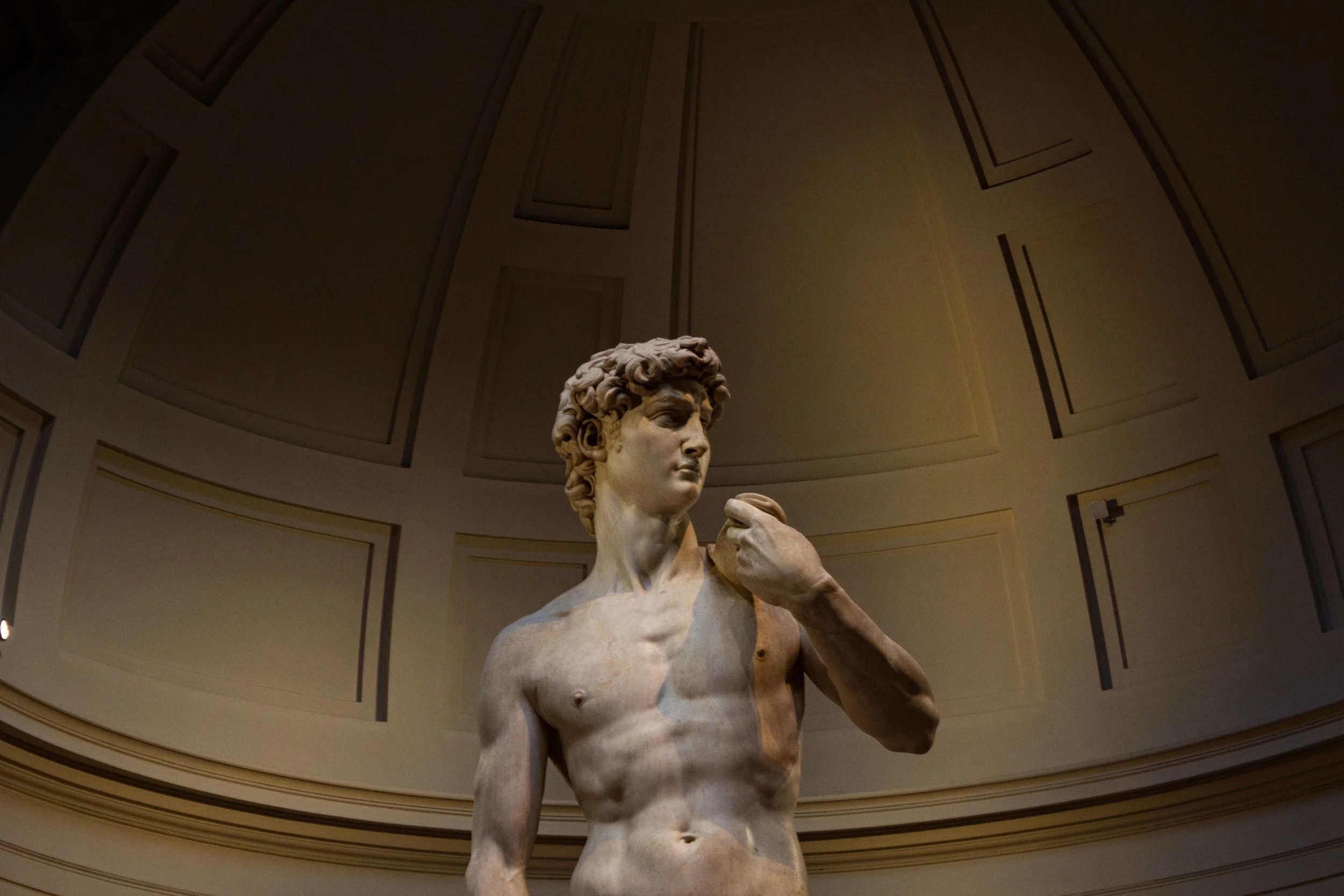
If your name is David, you entered the world with some fairly accomplished people already occupying the group chat.
A king.
A philosopher.
A prime minister.
A rock star.
A comedian.
A footballer.
A filmmaker.
A television host.
A painter.
A baseball legend.
No pressure.
The name itself comes from the Hebrew Dawid and is generally understood to mean “beloved.” Its endurance begins, of course, with the David.
Before Beckham bent anything, Bowie reinvented himself, or Chappelle walked onto a stage, there was a shepherd carrying a sling.
The First David
The biblical David enters history and tradition as an unlikely choice.
He is the youngest son of Jesse. A shepherd. Not the obvious warrior. Not the obvious king.
Then comes Goliath.
The story has survived for roughly three thousand years because its architecture is almost perfect: enormous problem, underestimated man, unconventional weapon.
David refuses Saul’s armor and fights with what he actually knows how to use.
That detail may be more important than the giant.
David doesn’t defeat Goliath by becoming a smaller version of Goliath.
He wins as David.
He eventually becomes king of Israel and one of the central figures of the Hebrew Bible, associated with Jerusalem, political power, military success, poetry, faith, enormous achievement and equally enormous human failure. The historical reconstruction of his reign remains debated, but his cultural influence is indisputable. The Davidic tradition became foundational to Judaism and Christianity and influential within Islam.
His legacy also contains something worth remembering whenever we turn historical figures into motivational posters.
David was complicated.
Courageous and flawed.
Faithful and destructive.
Triumphant and occasionally disastrous.
Being beloved never meant being perfect.
Perhaps that is part of why the name survived.
There Are A Lot of Us
David didn’t merely survive antiquity.
He became one of the most durable male names in the Western world.
In the United States alone, more than 3.5 million boys were named David between 1926 and 2025, making it the fifth most common male name of the past century, according to the Social Security Administration.
Its staying power is remarkable.
David was America’s sixth-most-popular boys’ name of the 1940s, fifth in the 1950s, fourth in the 1970s and fifth in the 1980s. Even during the 2000s, it remained No. 12.
And in 2025?
No. 35.
Thousands of years after a shepherd supposedly walked toward a giant with five stones, parents are still looking at newborn sons and saying:
David.
The name has crossed languages, nations, and centuries. Its variants appear throughout Europe and beyond, while its biblical associations helped make it especially enduring in Britain, Wales and Scotland.
For something meaning “beloved,” people have apparently taken the assignment seriously.
The David Hall of Fame
With several million Davids walking around, eventually we were going to get competitive.
So, with apologies to every David about to send me an angry email, here is an entirely unofficial Hall of Fame.
The Original: King David
Shepherd. Warrior. Poet. King. The franchise founder.
Philosophy: David Hume
One of the defining thinkers of the Scottish Enlightenment. If you’ve ever questioned whether humans are nearly as rational as we pretend to be, Hume was there centuries before you.
Politics: David Lloyd George
Prime Minister of the United Kingdom through the final years of World War I and one of the dominant British political figures of his era.
Exploration: David Livingstone
Physician, missionary, and explorer whose expeditions made him one of the nineteenth century’s most famous Europeans in Africa, though modern assessments necessarily contend with the complicated colonial world surrounding his work.
Music: David Bowie
This category isn’t particularly close. Bowie didn’t merely make music. He demonstrated that identity itself could become an artistic medium.
Comedy: Dave Chappelle
One of the defining stand-up comedians of his generation, capable of turning cultural discomfort into the setup instead of avoiding it.
Film: David Fincher
Se7en. Fight Club. Zodiac. The Social Network.
Television: David Letterman
More than three decades of late-night television and an enormous influence on the dry, ironic comedic language that followed him.
Art: David Hockney
One of Britain’s most consequential living artists, instantly recognizable without becoming creatively stationary.
Football: David Beckham
Manchester United. Real Madrid. England. Global celebrity. Then the unusual second act of converting athletic fame into durable business and cultural relevance.
Baseball: David Ortiz
“Big Papi.” Three World Series championships with Boston and a place in the Baseball Hall of Fame.
Wild Card: David Attenborough
Broadcaster, natural historian, and owner of perhaps the only voice capable of making two beetles fighting over a leaf feel like the fall of Rome.
Different centuries.
Different countries.
Different disciplines.
Same four or five letters.
Now Forget All of Them
This is the important part.
If your name is David, none of those men actually tells you what to do with it.
That’s the trap of inheritance.
We can become so impressed by what came before us that we confuse precedent with instruction.
The original David didn’t.
When they offered him someone else’s armor, he took it off.
There is something almost suspiciously appropriate about that lesson surviving inside this particular name.
You don’t need Bowie’s reinvention.
Beckham’s right foot.
Chappelle’s timing.
Fincher’s eye.
Hume’s mind.
Ortiz’s bat.
Or the first David’s sling.
You need to figure out what works in your hands.
Maybe you build a company.
Maybe you teach.
Maybe you raise extraordinary children.
Maybe you write something worth keeping.
Maybe you become the first person in your family to accomplish something.
Maybe your greatest achievement never becomes famous at all.
There have been kings named David and men named David whom history forgot completely.
Both were beloved by somebody.
That’s enough to remind us that a great name isn’t an accomplishment.
It’s an inheritance.
The original meaning was given to us thousands of years ago.
Beloved.
Everything after that is still available.
So if your name is David, appreciate the company.
Respect the history.
Study the people who carried it well.
Then stop trying to live up to them.
There are already enough famous Davids.
Be your own David.